


Sunday River - A Year Later, 10 Lessons from Making an Album Independently

Updated: 6 hours ago
It's hard to believe it's been a year since I released Sunday River.
What started as a collection of songs became a whole lot more: an album, vinyl and CDs, artwork, videos, two launch gigs, promotional campaigns and a series of live performances. And, as I've discovered, releasing an album independently involves rather more than just writing and recording the songs.

.The album was entirely self-funded, with no support from NZ On Air, traditional radio stations or any media of note to begin with. There was no record company behind me, no big promotional budget and no magic formula. Just songs I believed in, some very talented people who helped bring them to life, and a determination to get the music out there.
A year on, I've been reflecting on what worked, what surprised me and what I'd do differently next time.
For anyone thinking about recording and releasing their own album, here are ten lessons from my experience.
1. It's All About the Songs
Everything starts with the songs. You need to believe in them yourself, because they will be with you long time - writing, rehearsing, recording, promoting and performing them.
It's also important to get them into a state where they're ready to record. That doesn't mean every arrangement has to be set in stone, but you need a strong sense of what each song is about and where you want to take it. This is where having any chance to perform your songs is a good idea - busking at the local market every couple of weeks for example was essential. Nothing like a live audience!
With Sunday River, I wanted to make an album that reflected my own musical influences and experiences, with songs that could stand on their own. Essentially this album was about people and places .The title track, "Sunday River (Ōtautahi)", connects Sunday River in Maine with my hometown of Christchurch and its post-earthquake rebuild. "Len" is about my grandfather and his wartime experiences, "John & Warren" is a nod to John Prine and Warren Zevon, two huge influences.

An album is a significant investment of time and money. Make sure you've got songs you genuinely want people to hear.
2. Surround Yourself with Good People
Doing everything independently doesn't mean doing everything yourself. In fact, one of the most rewarding aspects of making this album was working with a group of musicians who brought their own ideas, experience and personality to the songs.
The album features:
Me — Vocals, Guitars, Mandolin, Harmonica
Quinn Mannix — Backing Vocals, 6 & 12 String Guitars
Caleb Barlow — Electric & Slide Guitar
Matt Clapp — Bass
Kalani Fogelele — Drums
Michael Davis — Double Bass
Andre Panere — Guitar
Louise Morgan — Backing Vocals
Sacha Kirkwood — Backing Vocals
Jackson Watkinson — Keyboards, Strings, Percussion

Caleb, Quinn, Matt and Kalani also make up Florida Man, and various members joined me for both album launch performances.
I was fortunate to have Jackson Watkinson from Levi Recording Studios involved, along with Jack Lanham from Moonbase Collective. Diana Castle created the artwork, while CatchLight helped with the website and Neato worked with me on the video and promotional side of things.

The lesson here is simple: find people whose skills you respect, trust their judgement and give them room to contribute. You might be funding the project, but you don't have to have all the answers.
3. Be Open to Ideas and Happy Accidents
You might arrive at the studio with a clear idea of how a song should sound, but don't be so attached to that vision that you miss something better.
Jackson added imaginative percussion and keyboards throughout the album, most notably on Señor Senior. Jack Lanham then brought everything together with crisp mixing and mastering at Moonbase Collective.

One of my favourite production decisions came relatively late in the process: having Quinn play 12-string electric guitar. The Ebow on Sunday River (Ōtautahi) was another important element, drawing on the influence of early-'80s guitar bands such as Big Country.
I'd also put album sequencing in this category. The order of the tracks affects how an album flows and how the listener experiences the songs together. And if you're planning a vinyl release, you need to pay attention to the total running time and the practical limitations of the format.
4. Physical Product Still Matters
In an age when music is increasingly consumed through streaming services, it's reasonable to ask whether vinyl and CDs are worth the expense.
For me, the answer is yes.
There's something satisfying about holding an album you've made - read the credits, look at the artwork and own a physical copy of the music.
As mentioned, Diana Castle created the design, including the wraparound cover photograph, centre labels and CD disc artwork.
The cover image was taken, unbeknownst to me, while I was admiring the New England autumn colours in Sunday River, Maine, back in October 2022. Louise said, “That's the album cover shot,” and she was right. Anything without the need to pose suits me!
The wraparound photograph was my idea, inspired by Roxy Music's Flesh & Blood album. The centre labels and CD artwork also show what I was taking a photograph of, bringing the visual story together.
Physical product costs money, so you need to think carefully about quantities, manufacturing costs and how you're going to sell and distribute it. But I wouldn't want to release an album without having something tangible to offer people.
5. Give the Launch the Attention It Deserves
An album launch is more than just another gig. It's an opportunity to celebrate the music, bring people together and give the release a proper sense of occasion.
For Sunday River, I actually had two launches.
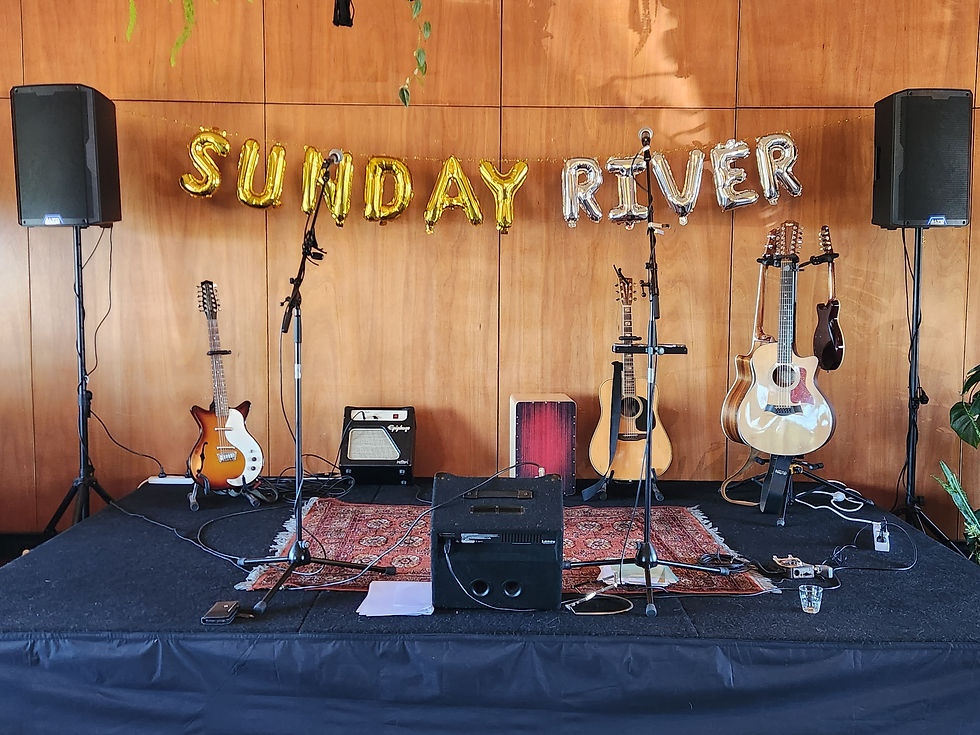
The first was a private launch on 1 November 2025, with family and friends at The Lair at Evil Genius. There was a nice symmetry to that venue, as it's also where I host my Open Mic nights and filmed both videos Sunday River Otautahi and Goodnight Tonight. Some of the Florida Man musicians, including Kalani and Quinn, joined me and the great Michael Davis turned up to recreate the upright bass parts on "Len" and "Senior Senor"

The public launch followed on 9 November at Space Academy. It was a small but enthusiastic crowd, with Caleb, Quinn and Kalani from Florida Man joining the performance.
Both events were important milestones. After all the time spent writing, recording and preparing the album, it was great to share the music with people in a live setting.
My advice is to plan the launch properly. Give people plenty of notice, promote it consistently and set realistic ticket prices. You want to make the event accessible while recognising the costs involved in putting it on.
And take plenty of photographs. They're useful for the blog, social media and future promotion - and, a year later, they bring back some great memories. Even the cake deserves a place in the story!
6. Promotion Is Part of the Job
This is perhaps the biggest reality check for anyone releasing music independently: finishing the album is only part of the work.
You also have to tell people it exists.
That means contacting radio stations, approaching music writers and bloggers, preparing press material, updating your website and finding ways to get the album in front of potential listeners.
I didn't have initial support from NZ On Air, radio stations or other media outlets, so I had to take responsibility for getting the music heard.
There were encouraging responses. Fatea Magazine in the UK described the album as “an album that deserves to be heard”, while veteran New Zealand music reviewer Graham Reid praised it for its “strong discrete songs with impressive musicians in support”.
The important lesson is not to expect everything to happen on release day. Promotion takes persistence, and you need to keep looking for opportunities long after the initial excitement has passed.

7. Make Videos and Plan Your Social Media
Video and social media are closely connected, so it's worth thinking about them together rather than treating them as separate jobs.
Working with Neato gave me the opportunity to develop the visual side of the project and, later, to run a more coordinated promotional campaign.
Social media needs a plan, too. Posting the occasional album cover and hoping people will notice isn't enough. Think about what you can share before release, on release day and in the months afterwards.
The campaign I did with Neato mid-year was a good example of what can be achieved when the activity is coordinated. Rather than relying on one announcement, you have different ways to bring the album back to people's attention.
There's plenty of material to draw on: the stories behind the songs, recording sessions, the musicians involved, the artwork, reviews, live performances and behind-the-scenes photographs.
The other lesson is that you don't need to stop talking about an album once the release campaign is over. An anniversary is a perfect opportunity to revisit it , which is exactly what I'm doing here.
8. Get Out There and Play Live
If possible, don't make the album launch your only performance.
Playing live gives the songs a life beyond the recording and creates opportunities to reach new audiences. It also gives people a chance to meet you, buy a copy of the album and become part of your musical world.
Two highlights from the past year stand out for me.
The Lavender Field Concert, alongside Australian band Rufous Whistler, was a wonderful experience. There was a great sense of camaraderie and the setting was fantastic.

Then there was Castle Hill Rocks, where I had the opportunity to share the stage with Holly Arrowsmith and mix with some impressive musicians with real pedigree in an incredible setting an hour away in the alpine Castle Hill village.
A run of gigs can be difficult to organise when you're doing everything yourself, but it's worth looking beyond the launch night. Even a handful of well-chosen performances can help extend the life of an album.
9. Don't Forget the Merchandise
One thing I wish I'd done differently was have T-shirts available when the album came out.
Merchandise offers people another way to support you and helps extend the identity of an album beyond the music itself. A good design can become something people are happy to wear, rather than simply another souvenir.
Of course, you need to balance the potential benefits against the cost of producing stock. Think about quantities, sizes, designs and whether people are likely to buy what you're offering.
I'm only getting around to doing this now, a year after the release. It's a reminder that merchandise should be considered alongside the artwork, vinyl and CDs, rather than left until later.
10. Keep the Momentum Going
The final lesson is that an album release is not a single event. It's an ongoing project.
The initial launch and promotional activity are important, but what happens in the following months matters just as much. Keep playing live, share new material, revisit the songs and look for opportunities to introduce the album to people who haven't heard it yet.
The reviews from Fatea Magazine and Graham Reid, the work with Neato, the live performances and the continuing availability of the physical album have all contributed to the life of Sunday River beyond its release date.
Looking back, I can see things I'd approach differently next time. I'd have a range of merch ready, think even further ahead about the promotional campaign and continue to look for opportunities to take the music to new audiences.
But I'm proud of what the album became, the people who helped make it happen and the experiences that have followed.
A Year Later
Releasing Sunday River has taught me a great deal about songwriting, production, collaboration, organisation, promotion and the realities of being an independent musician.
You don't necessarily need a record deal, a big budget or immediate media attention to release an album. You do need songs you believe in, people you trust, a realistic plan and the determination to keep going when the initial excitement of release day has passed.
I'm grateful to everyone who played on the album, helped make it, came along to the launches, reviewed it, bought a copy, watched a video or came out to a gig.
However, releasing the album isn't the end of the process. It's the beginning of the next chapter!


Comments